By Chandrajit Pati
CEO, Committed People HR Advisory
Most organization redesigns do not fail because the strategy behind them was wrong. They fail because the design work itself walks into a small set of avoidable traps — the same ones, in different disguises, across industries and geographies. Having worked on operating-model redesigns across sectors, I have found that leadership teams rarely lack good intentions. What they lack is a disciplined way to catch these traps before they get built into the org chart and become expensive to reverse. Below are seven of the most common ones, along with how they tend to surface in practice and what has worked to avoid them.
Trap 1: Copying a structure instead of designing one
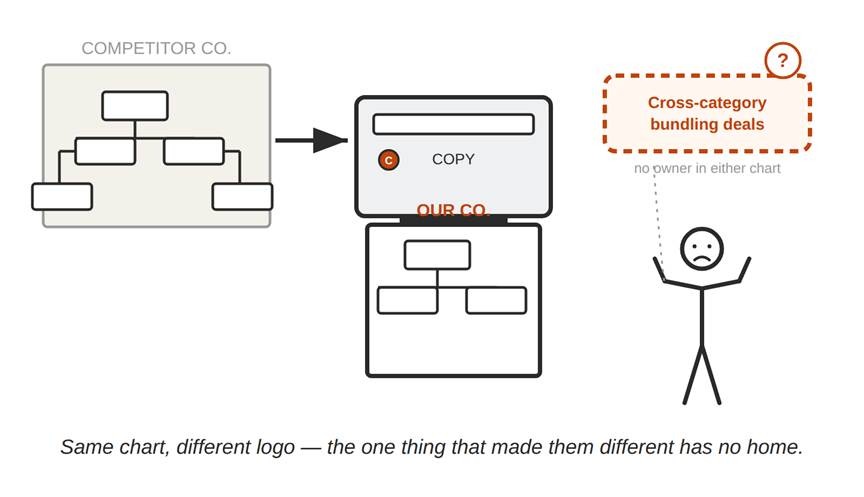
Many companies redesign by benchmarking a competitor’s org chart or adopting whatever model is fashionable that year, without asking what their own structure needs to protect. A structure is only right if it puts management attention exactly where the company’s competitive edge lives.
Consider a mid-sized speciality food manufacturer that reorganized along geography simply because that was the industry norm. Its actual advantage, however, was the ability to bundle products across categories for a handful of large retail chains — a capability that no single geographic unit was responsible for. After the reorganization, no one owned the retail-bundling relationship, cross-category deals stalled, and revenue growth flattened for the better part of two years before the gap was noticed and fixed.
The fix is simple to state and hard to do: before drawing any boxes, name the two or three things the company must be better at than competitors, and make sure the design gives each of them an explicit owner.
Trap 2: Redrawing boxes without changing how decisions get made
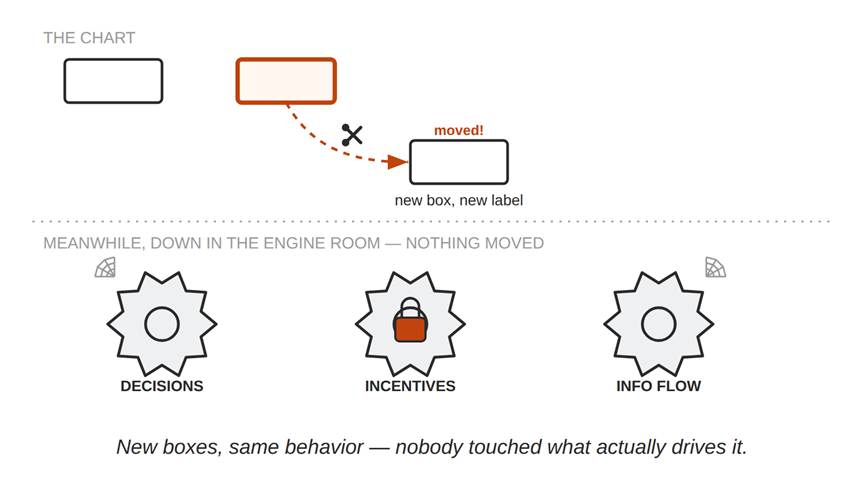
A new structure changes who reports to whom, but it rarely changes, on its own, how decisions are actually made, how people are rewarded, or what information reaches the right desk at the right time. Leaders who treat structure as a redesign process only are usually disappointed six months later when behaviour hasn’t shifted.
A logistics company once merged two regional divisions into one to simplify reporting lines but left the old regional bonus pools untouched. Managers kept optimizing for their former region’s numbers, because that is what they were still paid to do, and the promised synergies never showed up in performance.
Structure must move together with decision rights, incentives, and information flow. Changing the chart without touching the other three is close to changing nothing.
Trap 3: Splitting accountability so finely that no one owns the outcome
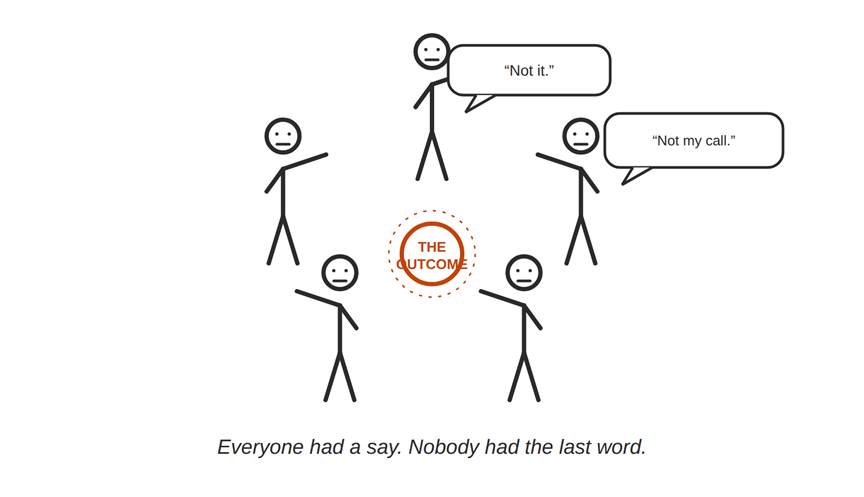
Shared ownership sounds collaborative, but in practice it is one of the fastest ways to kill a strategic initiative. When a result depends on five stakeholders each holding a partial veto, the most likely outcome is delay, not consensus.
An electronics company once split accountability for a flagship product launch between regional general managers and a global product head, believing this would balance local relevance with global consistency. In practice, seven people had partial sign-off, and no one had final authority. The launch missed its window by a full selling season while the group debated packaging.
Every important outcome needs one name attached to it — not a committee, and not a matrix cell shared by two peers with equal authority.
Trap 4: Building a matrix that looks elegant on paper and collapses under pressure
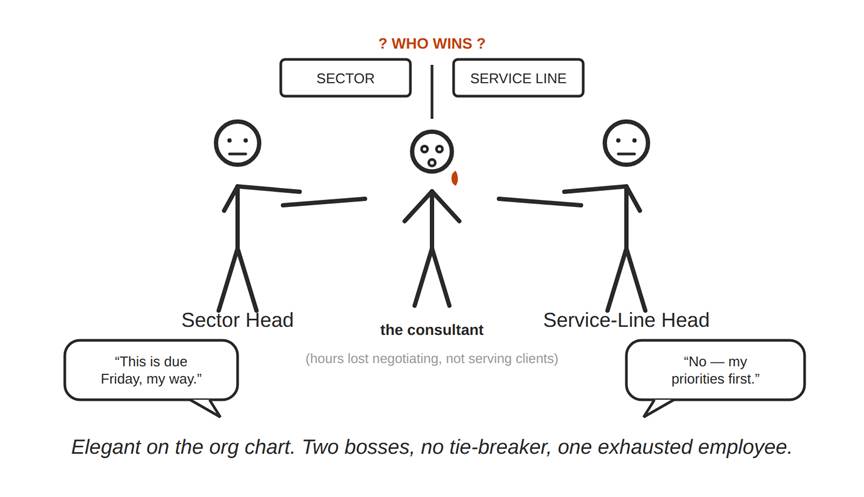
Matrix structures are attractive because they promise the best of two worlds — say, deep functional expertise and strong customer focus — without forcing a trade-off. In practice, a matrix works only when it is explicit about which dimension wins when priorities conflict.
A professional services firm introduced a matrix combining industry sectors and service lines, with consultants reporting into both. Without a tiebreaker, staff spent more hours negotiating between two partners with competing priorities than serving clients, and utilization fell noticeably within a quarter.
If a matrix is unavoidable, name a primary dimension for each role and give someone clear tie-breaking authority for the disputes that will inevitably arise.
Trap 5: Designing for an idealized workforce instead of the one you actually have
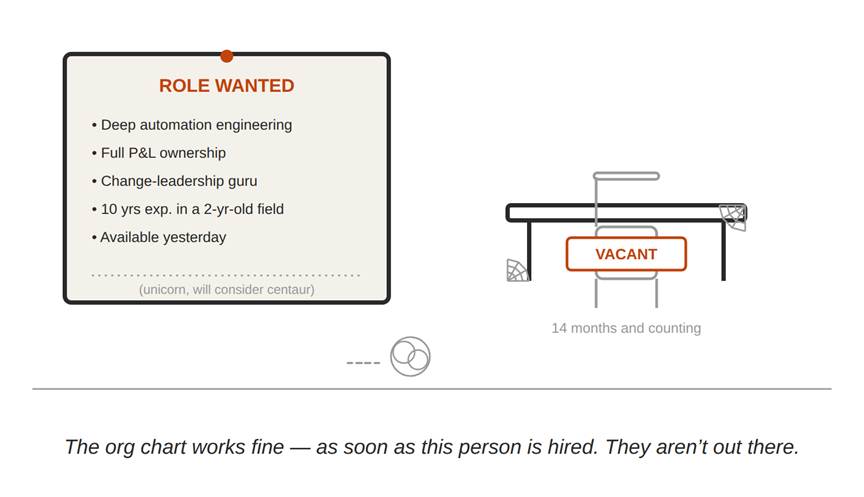
An organization chart is only useful if real people can be found to run it. Designs built around a hypothetical “ideal” manager — someone with a rare mix of technical depth, commercial judgment, and change-leadership skill — routinely leave critical roles unfilled.
A manufacturer once created a digital-transformation lead role that combined deep automation engineering, large-scale change management, and full profit-and-loss ownership. The role sat vacant for over a year, and the initiative it was meant to drive stalled with it.
Test any new structure against the actual talent bench and the realistic hiring market, not against a wish list. Where a gap exists, plan explicitly for how it will be closed, rather than assuming the right person will simply appear.
Trap 6: Adding a layer to solve a political problem
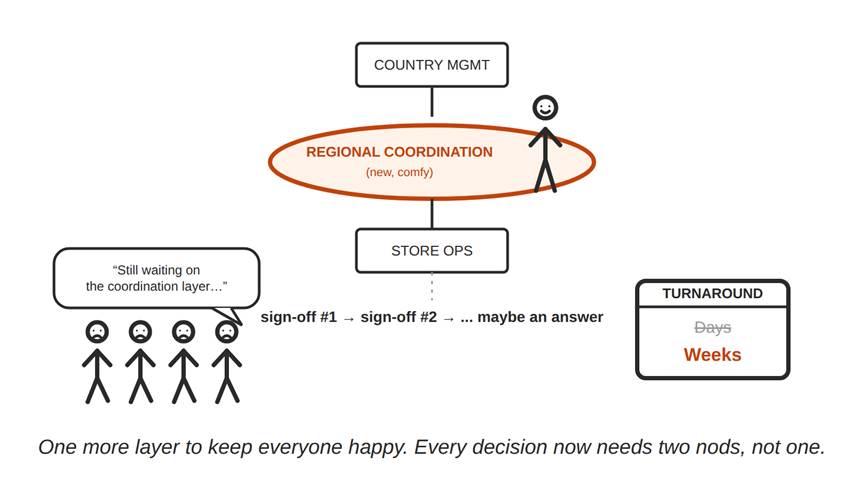
New layers of management are sometimes added not because they add value, but because they offer a face-saving role for a senior executive who might otherwise be displaced. These layers rarely disappear once created, and each one slows decisions further.
A retail chain added a regional coordination layer between store operations and country management, intending to speed up local decisions. Instead, every action now needed sign-off from two levels instead of one, and decisions that used to take days began taking weeks.
Before adding any layer, ask what it will decide that the level below cannot, and hold it to a visible standard: it must measurably improve the performance of the units beneath it, or it should not exist.
Trap 7: Treating the design as finished once it is announced
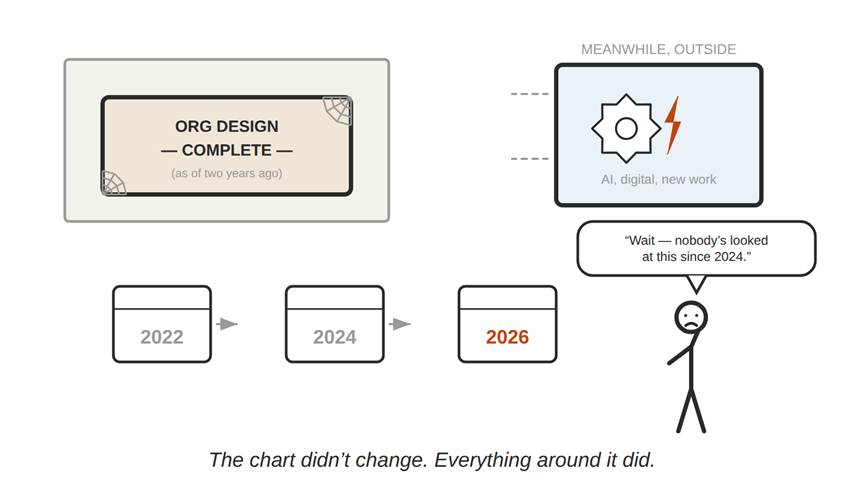
A structure that fit the business two years ago may actively work against it today, particularly as digital tools and AI-enabled ways of working change how work actually gets done. Organizations that treat their structure as a permanent fixture, rather than something to be re-tested periodically, tend to discover its flaws only during a crisis.
The most resilient organizations treat design as an ongoing discipline, not a one-time announcement. They build in a regular review mechanism to test whether the structure still works as intended:
- Does it still direct leadership attention to what matters most?
- Are there clear owners for the outcomes that matter?
- Does it reflect the talent the organization actually has, or can realistically build?
This habit is what separates structures that age well from those that quietly calcify.
In conclusion, none of these traps requires a sophisticated diagnosis to avoid. They require leaders willing to ask uncomfortable questions before the design is finalized, rather than after it has failed.
Organizations that build this discipline into how they design — not just what they design — are the ones that turn structural change from a recurring crisis into a genuine source of competitive advantage.


Leave a Reply